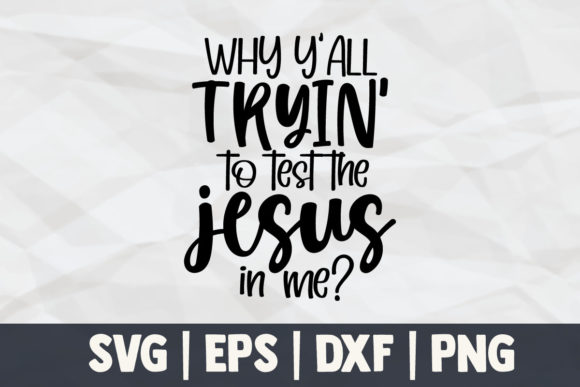
Why Y’all Tryin’ to Test the Jesus in Me
When I first opened the Why Y’all Tryin’ to Test the Jesus in Me embroidery file, I knew immediately this was not a quiet, subtle design. It has attitude. It has voice. And it has a very specific personality that will either land perfectly with your customer or send them scrolling past. As someone who has tested hundreds of machine embroidery designs across every fabric and product type I can get my hands on, I want to walk through what this design actually does when it moves from a digital file to a finished product.
First Look and the Mood It Sets
The design reads like a bold statement piece. The phrase itself carries a mix of Southern charm, faith, and a warning all at once. That kind of energy is hard to pull off in embroidery because the medium demands clarity. If the lettering gets muddy or the layout feels cramped, the message falls flat. From what I see in the file structure, the composition is balanced with enough breathing room around the words so that each character holds its own. The visual personality is direct, unapologetic, and made for someone who wants their project to speak before they do.
This design belongs naturally on products that get seen and used daily. Think custom apparel like a sweatshirt or a t-shirt, a sturdy tote bag design for farmers markets or church groups, or even an embroidered patch that can be ironed onto a jacket or backpack. The tone is conversational but firm, and that makes it a great conversation starter for small shop merchandise or holiday gifts that carry a personal message.
Real Case Scenario: The Tote Bag Test
I ran a test project with this design on a midweight cotton canvas tote bag. The fabric had a bit of texture but nothing extreme. I used a medium-weight cutaway stabilizer and hooped the bag carefully to avoid shifting. The stitch density felt reasonable through the run. The lettering came out crisp, and the satin stitch areas held their shape without puckering. I used a dark thread color on a natural cream bag, and the contrast was sharp enough that the message read clearly from across a room.
I showed the tote to a few customers at a local craft fair, and the reaction was immediate. Some laughed. Some nodded. A few asked if I could make one for them in a different color. That kind of engagement is rare for a single design test, and it told me that Why Y’all Tryin’ to Test the Jesus in Me has real commercial potential for Etsy sellers and small shop product lines. It also works well as a personalized gift for someone who appreciates faith-based humor with a backbone.
Apparel and Sweatshirt Embroidery
On a sweatshirt, this design sits nicely across the chest or centered on the back. The lettering is bold enough that it doesn't get lost in the fabric nap. I recommend testing a stitch-out on a scrap piece of the same fabric first, especially if you are using a fleece or terry cloth. The fill stitch areas need a stable base to keep the edges clean. Use a tear-away or cutaway stabilizer depending on the stretch of the garment. For custom apparel orders, this design is a strong candidate for boutique branding or small runs of faith-based merchandise.
Baby Embroidery and Nursery Decor
This is not a design I would put on a baby onesie or a nursery wall hanging. The tone is too adult in its humor and message. It belongs on products for teens, adults, or anyone with a fully developed sense of irony and faith. That said, if a customer specifically requests it for a baby item, make sure they understand the message and are comfortable with the contrast between the cute product and the punchy text.
Patches and Caps
As an embroidered patch, this design works well because the layout is compact enough to fit within a standard patch shape. I would use a dense satin stitch border to give it a finished edge. For caps or hats, be careful with the curve of the crown. The design has a horizontal flow that needs to be adjusted for curved surfaces. Use a hoop designed for cap embroidery and check the placement before stitching. The lettering should sit above the brim where it is fully visible and not distorted by the seam.
Aprons, Pillow Covers, and Kitchen Towels
These are underrated product categories for a design like this. An apron with this message becomes a statement piece for a cook who does not take nonsense. A pillow cover with it on the front adds personality to a living room or a man cave. Kitchen towels with this design make great holiday gifts for friends and family who appreciate humor with their faith. The fabric on towels and aprons is usually stable enough to hold the stitch detail, but test a corner first to make sure the thread colors pop against the background.
Where to Use This Design Carefully
Not every fabric or product is a good match for Why Y’all Tryin’ to Test the Jesus in Me. Here are a few situations where I recommend extra caution or a complete pass:
- Small hoop sizes: If you are working with a 4x4 hoop, the design may need to be scaled down, and that can make the lettering too small to read clearly. Check the hoop size requirements before committing to a small product.
- Thin or stretchy fabric: Lightweight knits and jersey fabrics can cause the stitches to pull and distort the design. Use a stabilizer that can handle the stretch, and consider a running stitch underlay to anchor the fill areas.
- Dark fabric: If the design is meant to be stitched in a light thread color on a dark background, the contrast can be striking. But if the stitch density is too light, the dark fabric will show through and make the text harder to read. Test a sample first.
- Layered garments: Jackets or hoodies with multiple layers can cause the needle to skip or break if the design is too dense. Reduce the density slightly or use a heavier stabilizer.
- Curved surfaces like caps: As mentioned, the horizontal layout needs careful placement on a curved surface. Test the design on a scrap cap before stitching a customer order.
- Frequent washing: Products like kitchen towels or tote bags that will be washed often need a stable thread and a well-secured design. Use a satin stitch with a good underlay to prevent fraying over time.
Visual Appeal and Product Value
When a design is well-executed, it elevates the entire product. Why Y’all Tryin’ to Test the Jesus in Me has the kind of visual appeal that makes a handmade product look intentional and professional. The spacing, the font choice, and the overall layout contribute to a finished look that feels like something you would buy at a boutique or a craft fair, not something that was thrown together in a hurry.
For handmade product sellers, this design adds value because it taps into a specific audience. Faith-based consumers who also appreciate humor and directness are a loyal customer base. When you stitch this design onto a quality product, you are offering more than just a piece of apparel or decor. You are offering a statement that resonates with their identity. That kind of connection builds customer trust and encourages repeat business.
In terms of brand consistency, if your shop already has a line of faith-based or humorous designs, this one will fit right in. It also works well for printable mockup presentations because the layout is clean and easy to photograph. When you list it on your Etsy seller store, use mockups that show the design on a variety of products to give potential buyers a clear idea of how it will look in real life.
Practical Embroidery Designer Notes
Before you stitch this design on a customer project or a product for your own shop, here are a few practical steps I recommend based on my own testing:
- Test on scrap fabric first. Always. This is the number one rule of machine embroidery design work. The file may look perfect on screen, but fabric and thread behave differently.
- Check thread color contrast. Hold your chosen thread colors against the fabric you plan to use. If the contrast is too low, the text will be hard to read. If it is too high, the design may feel harsh. Find a balance.
- Review stitch density. If the design has dense fill areas, make sure your stabilizer can handle it. Adjust the density if needed, but do not change it so much that the design loses its shape.
- Confirm hoop size. Measure the design dimensions and compare them to your hoop size. Do not try to squeeze a design into a hoop that is too small. It will lead to poor stitch quality and frustration.
- Inspect small details. Look at the corners of the lettering and any decorative accents. If the stitches are too tight or too loose, the design may need editing before you use it.
- Test in black and white mockups. Sometimes a design looks great in color but loses its structure in a single-color stitch-out. Test it in black and white to see if the layout holds up.
- Compare light and dark fabric backgrounds. The same design can look completely different on a white shirt versus a black one. Stitch a sample on both to see which one works better for your product line.
- Use proper stabilizer. For this design, a medium-weight cutaway stabilizer is a safe starting point. Adjust based on the fabric type and the stitch density of the file.
- Check licensing before selling. Since this is a digital embroidery file listed under Crafts and Graphics, confirm whether the license allows commercial use. If you plan to sell finished products or use the design as a design asset for multiple projects, make sure you are legally covered.
- Keep a test sample for reference. After you stitch a successful test, keep it on hand. It helps when discussing custom orders with customers and gives you a benchmark for future projects.
Final Thoughts on This Design for Real Use
Why Y’all Tryin’ to Test the Jesus in Me is not a design for every customer or every product. But for the right audience, it is a strong addition to any embroidery project lineup. It has personality, it has clarity, and it has the kind of directness that makes people stop and look. Whether you are stitching it onto a tote bag for a craft fair, a sweatshirt for a custom order, or a pillow cover for a holiday gift, the design holds up well when you take the time to test it properly.
For Etsy sellers and small business owners looking to expand their handmade product offerings, this design is worth a close look. It fills a specific niche without being gimmicky. It speaks to a real audience with real interests. And when it is stitched with care and attention to detail, it becomes a finished product that people will actually want to buy, wear, and share.
As always, test your materials, check your settings, and know your customer. That is the difference between a design that sits in a drawer and one that sells out at your next show.